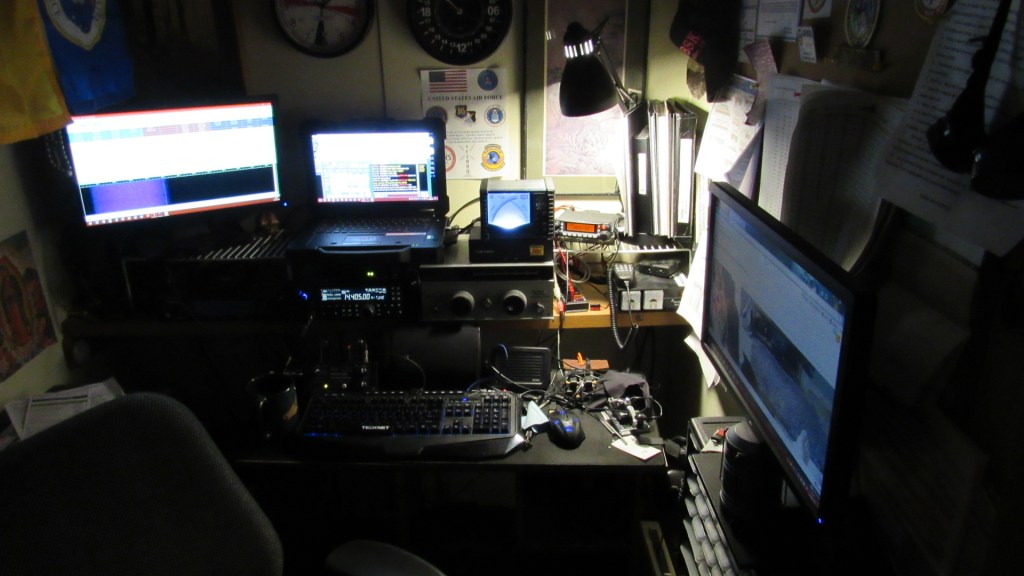
Owing to the need for a central point for a power supply, antenna feed lines, grounding cables, and centralized operation, most amateur radio operators create a single space where all the base communications are installed together. In radio code this is called your QTH, your station’s location. It’s also called a ham shack or if you want to get nuts, the Community Communications Command and Control Center, “C5“. The major components are these:
- 12 volts DC power supply: this is how your typical American residences’ 110-120 volts AC gets turned into the necessary 12 volts DC. All radio’s need this type of power (pretty much). I’m using a Samlex SEC-1235M which has served me well. I haven’t been an operator long enough to use something different, but there are many good makes and models out there.
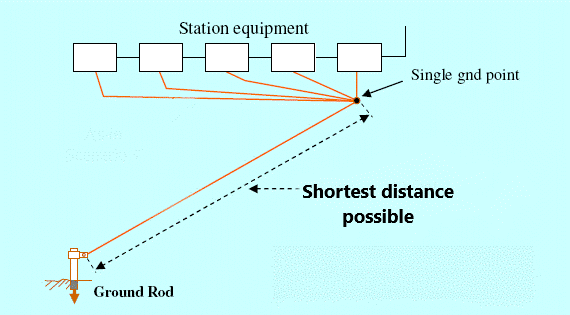
- Antenna Feed lines are very simply the cable, most commonly a 50 ohm coax cable (not to be confused with or substituted with cable TV coax), that takes the transmitting signal from the radio to the antenna, and the receiving signal to the radio from the antenna. There are other common types of antenna feedlines, but the radios and antennas I’m suggesting all use this same type of coax. This keeps things simple. They go from the radio to the antenna, shouldn’t be longer than necessary (always less than 100ft), and can be bought ready to install or cable can be bought in bulk and connectors soldered on.
- A wall ‘port’ is simply a place where all these cables cross from inside the shack to outside. There are very nice ports one can buy and install that create a water-tight interface that cleanly and neatly serves this purpose. It is most important if you are married and don’t want your spouse to freak out about holes in the wall and wires going everywhere. In my case a remnant dog door just happens to be in the right place. Choose wisely.
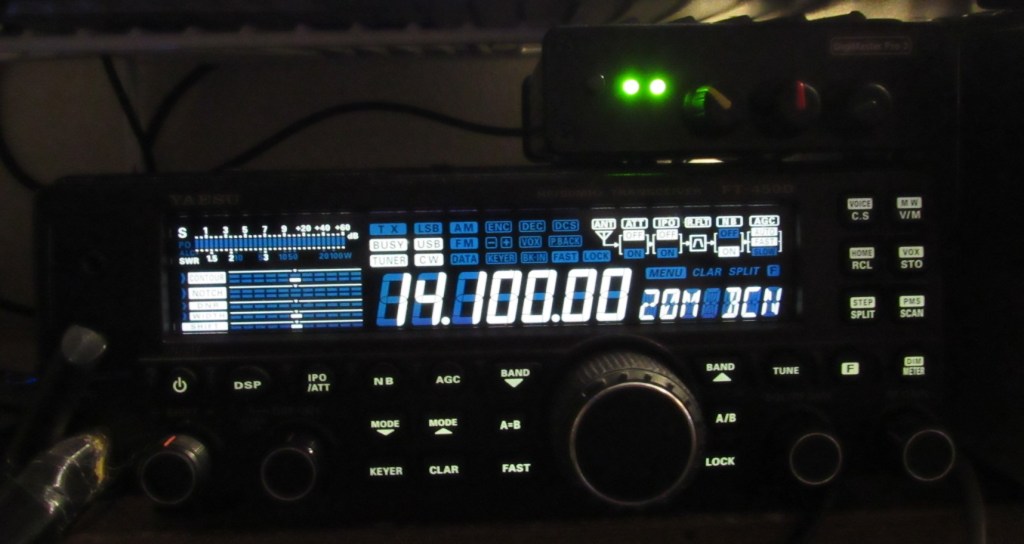
- Component arrangement is the physical set up of your radios, components, computer(s), displays, and everything else you’ll acquire that’s radio comms related that will end up in your shack. The first picture above shows my shack. A web search for images of ham shacks will show the wide wide world of ham shacks. It makes the nomenclature of the C5 not so far fetched. Yet this is my favorite ‘field QTH’ in much contrast: a Russian fellow I made contact with using a digital modulation mode called JT65 on the always busy 14.075.00 mhz USB (20 meter band):
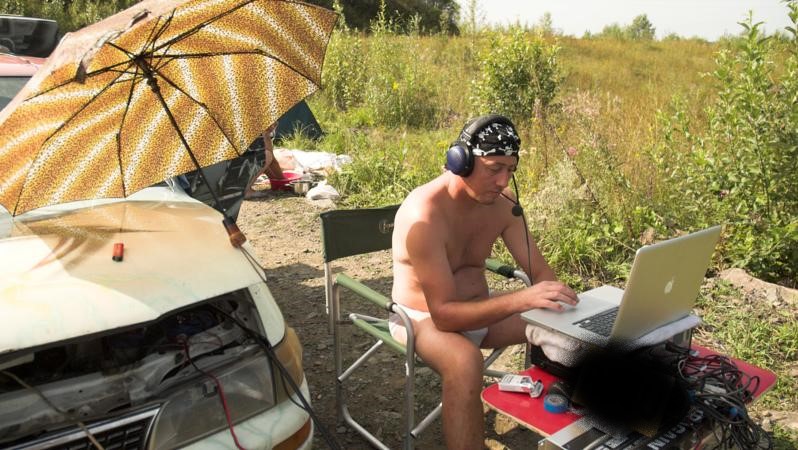
The irony here is that regardless of the fancy equipment, it comes down to persons skill; all those fancy ham shacks in the link above are nice, but it comes down to getting the message through, which this casual fellow in the picture is doing just fine.
So your own communications center is where you can manage communications for events in your community from a stationary and secure location. Your base station can have other functions such as maintaining a repeater (the highest location central to the community is often the ideal choice for a repeater), a packet mail node (like a email server, where messages can be stored and accessed. The most popular and easily used system is Winlink), a known location where people can physically meet to gather information and disseminate it, a Net Control station, (more on that later), and where different information is gathered from multiple radios and sources, 2 meter, HF, C.B. news, scanner, first hand observations. Often the cost involved can be prohibitive, and as a church oriented servant to your community, a great location for a base station would be your physical church or community center. This shared station allows people to get their Amateur Radio General license, the necessary license to access all the modes on the High Frequency bands (160 meters to 10 meters) without each person having to invest in separate shacks. It would be a long-term goal that everyone who can will get a shack, but having a shared, central amateur radio station that qualified operators can use and others can assist, is a great place to start. If there is only one station, choosing a place that is a community gathering place, has outside space for antennas, is on high ground, easy to secure in a disaster or other emergent event, can make it an obvious rallying point.
Coming soon: using radios with discipline and skill is as important as having them to begin with
 Sons Of Thunder Signal Corps Ministry